Choose a calculation and enter the known values
For E-I-R, choose the quantity to solve and enter the other two. For a resistor network, enter the applied voltage to get total current and power as well as the combined resistance.
SDG Electronicssdgelectronics.co.uk/tools/pcb-calculator/ohms-law/
Basic electrical relations, LED bias, passive networks and matched or unmatched Pi/T attenuators.
Enter your values to calculate a result.
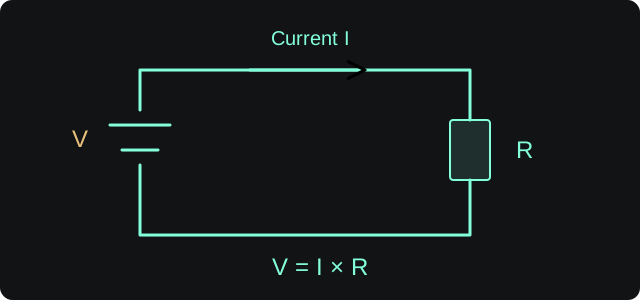
Voltage drives current through a resistance. Choose the quantity you want to calculate, then enter the other two. The same page also includes LED resistors, passive networks and attenuators.
Illustration only. Not to scale.Voltage
N/A
Ideal components only. Ohm's law uses V = IR and P = VI. Series and parallel networks use the usual component equations.
Pi and T attenuators use the standard two-port relations. For a matched pad, both ports have the same impedance. For an unmatched pad, enter Zin and Zout separately.
For E-I-R, choose the quantity to solve and enter the other two. For a resistor network, enter the applied voltage to get total current and power as well as the combined resistance.