SDG #287 LoRa Relay with the Seeed Wio-E5
This project episode addresses a practical problem: switching selected garden lights independently from a single armoured cable run, using a wireless relay rather than adding photocells and timers at every fitting. Commercial kinetic wireless switches were ruled out because they cannot pass local loads at the switch end, so a custom board built around the Seeed Wio-E5 LoRa module became the starting point.
The key finding is a protocol decision that matters to anyone shopping for these modules. The Wio-E5 ships with LoRaWAN firmware driven over AT commands, but LoRaWAN routes traffic through a gateway and out to the internet, adding tens of seconds of latency and requiring server side handling. That is unusable for a light switch. The workaround is the module’s built in TEST mode, which strips the WAN stack and exposes raw LoRa transmit and continuous receive commands, giving genuine point to point (and point to multipoint) operation. The trade-off is clear: no encryption at all, so packets can be sniffed and replayed unless rolling codes are added.
A custom two layer board pairs a PIC microcontroller with the module over one UART while echoing traffic to a PC on a second UART, making the AT exchange visible during development. Configured for 868MHz, SF12 and 125kHz bandwidth at minimum transmit power, the link held with zero dropped packets at roughly 250 to 300 metres, far beyond the 10 to 20 metres actually needed, which is a useful reminder about duty cycle etiquette on a shared band. Switch state mirroring works, with a deliberate delay to avoid flooding the band. Next steps are reflashing the module’s STM32 with custom firmware to remove the PIC entirely, and designing a mains supply capable of around 150mA peak at 3.3V.
More Electronics Projects

SDG #374 Smart Home Lighting: Adding Wireless DMX to My ESP32 Controller
Adding wireless DMX to an ESP32-S3 touch dimmer using ESP-NOW, with a 16-channel receiver, pairing, smoothing and scope-verified DMX output.
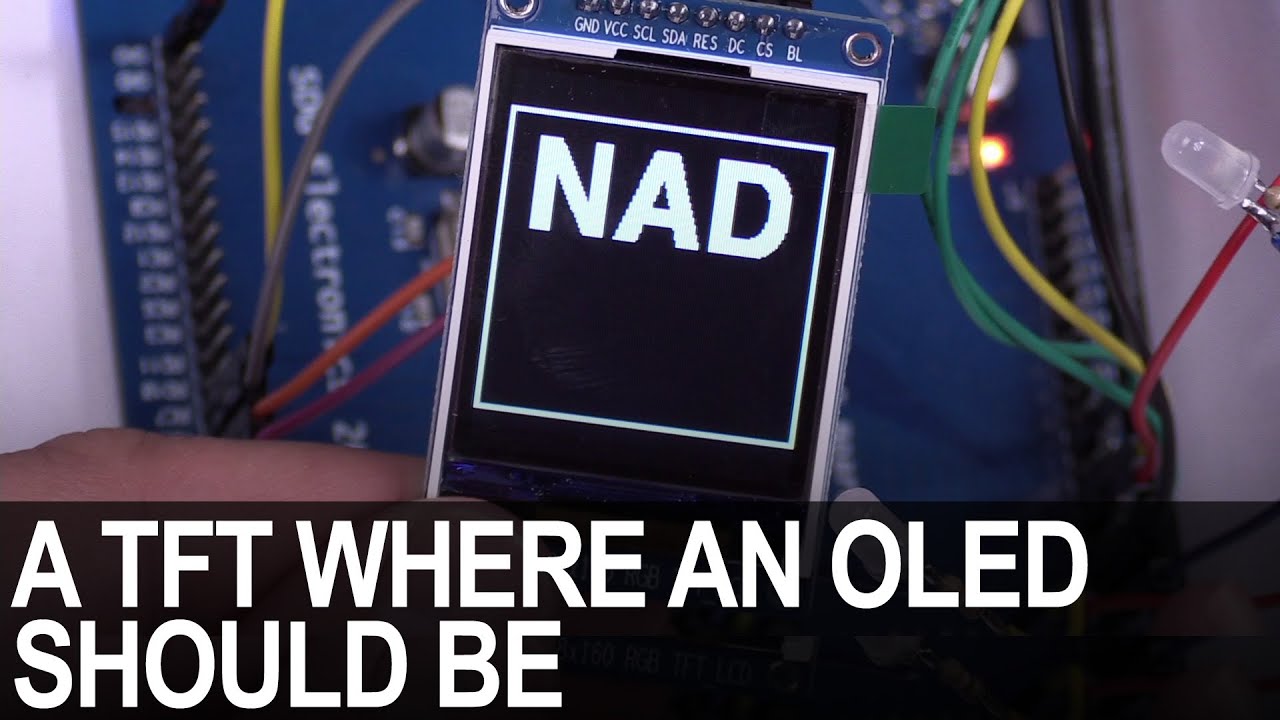
SDG #365 Reverse Engineering NAD D7050 OLED Replacement for IPS TFT
Decoding the NAD D7050's obsolete SSD1355 OLED protocol with a logic analyser, then driving an SSD1351 OLED and ST7735S IPS TFT as replacements.

SDG #360 Zero Crossing Detection and PCBWay 3D Prints
Testing PCBWay nylon PA12 and clear resin wall mounts for a Waveshare 4in ESP32-S3 touch dimmer, plus lower-power zero crossing detection options.