MiniWare AirGo 140 Review: 140 W Portable USB-C Hot Air Station
Episode 377 ·
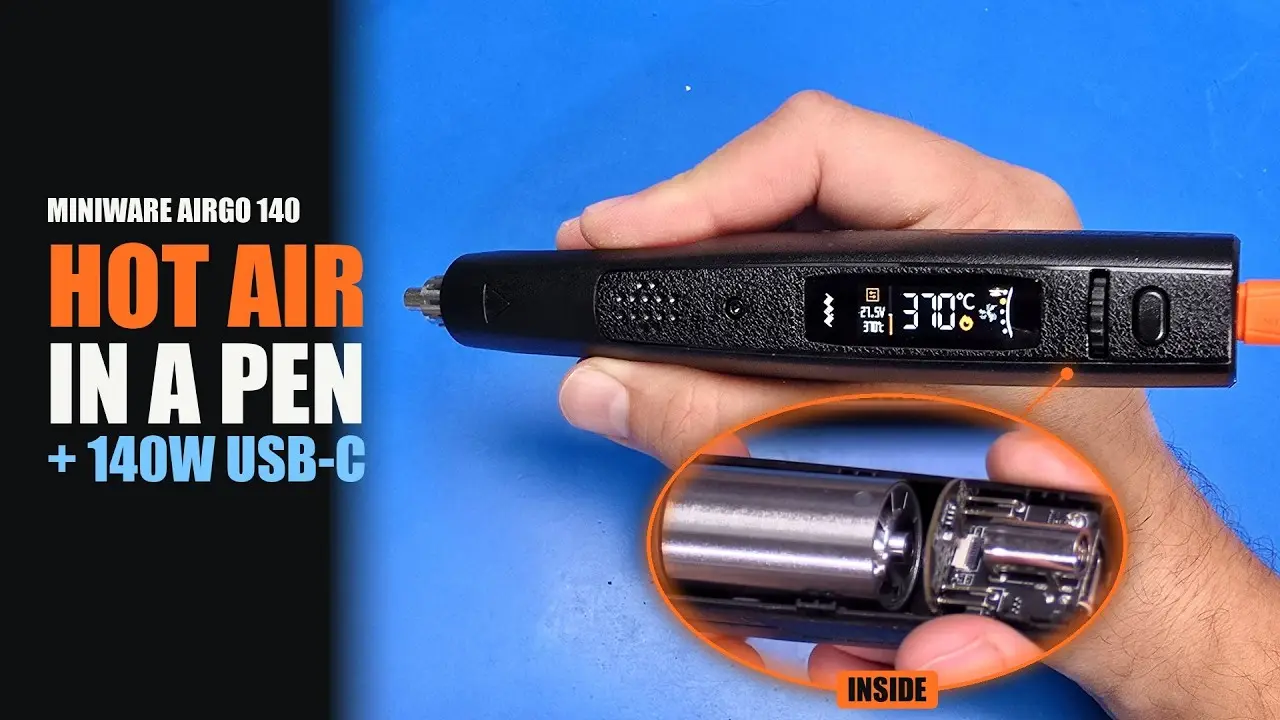
The MiniWare AirGo 140 is a 140 W hot air pencil that runs from USB-C, with Bluetooth control from a phone app. MiniWare sent it for review, along with its aluminium sleep stand and 140 W GaN charger. It’s meant for small soldering and desoldering jobs and occasional rework: taking hot air to a client’s site, or working on a bench without room for a full-size station, which it won’t replace. It comes in three kits, from about £75 for the pencil with its case and cable to about £130 with the stand and the charger. A thumb wheel, which also pushes to select, and a button set the temperature from 80 to 450 °C and the fan from level 1 to 5, and a colour TFT display shows the setting, the input voltage and a bar graph of the heater’s power. At the back are a USB-C port and a high-current DC jack, both taking 20 to 28 V. MiniWare recommends a supply that can deliver at least 140 W, which over USB-C means 28 V at 5 A; a smaller one still works, but heats more slowly and may not reach full temperature. The nozzle is fixed, about 5 to 6 mm across, and can’t be changed. In capability the AirGo sits just above the Metcal HCT2-120 pencil from #151. The stand is anodised aluminium and feels very well made: slide the pencil in and a magnet puts it to sleep, and it cools down with the fan running until it reaches about 100 °C. Inside, the heater sits at the front with a beautifully made brushless DC fan behind it, a USB-C power delivery board carries the DC jack at the back, and a control board with the MOSFETs, temperature measurement and display runs between them.
The presets are custom, general, large, precision and preheat, each with its own temperature and fan level. The settings also cover the standby time, idle detection, the display timeout, separate power limits for USB-C and the DC input, a standard or fast cool-down, brightness, volume, language and Bluetooth; the review unit ran firmware 1.2.2 on hardware B1.01. The temperature can be changed on the fly with the wheel, in 10 °C steps, but the dial-style digits shown while it heats are very hard to read, and that part of the firmware needs revising. The supplied orange cable drops about 1 V from the 28 V supply. Set to 330 °C, a thermocouple in the middle of the airflow read about 300 °C, so it runs about 20 to 30 °C low and is worth setting a little higher. It drew the full 140 W from the charger, and 136 W from a UGREEN 200 W power bank that can supply 28 V at 5 A, heating just as it did from the charger, so hot air rework is possible with no mains at all.
On a lead-free four-layer board with a ground plane, 0603 resistors and SOT-23 parts came off, but slowly, and a part with a heatsink pad drew a lot of heat away into the board. On a simpler two-layer board it heated parts quickly and worked well. The phone app shows the input voltage, the temperature and the fan speed (about 60,000 rpm while heating), plots the temperature on a graph, and changes the temperature, fan level and preset on the pencil itself. It can also start the heater remotely, which could be dangerous, and its power figure read 250 W for no obvious reason. The verdict: like the Metcal and other hot air pencils, it’s a niche tool, ideal for precision work. With one small nozzle, the air can’t get round all the pins of a part bigger than the nozzle, so larger parts, and boards with a lot of copper such as phones, are beyond it. With an infrared or convection preheater bringing the board up to about 100 °C first, it can take on more demanding work. It’s now in the specialist group of the hot air station rankings.
More Miniware
 Length 15:51
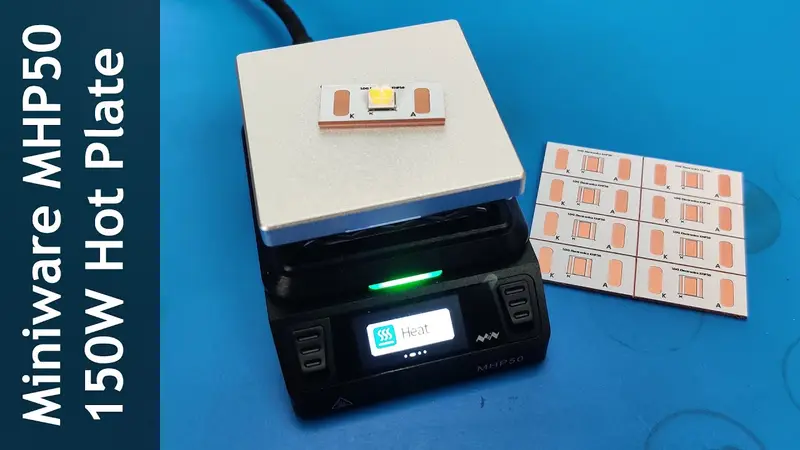
Miniware MHP50 Mini Hot Plate Preheater Review
Hands-on review of the Miniware MHP50 USB-C hot plate: heat-up speed, reflow profiles, real PCB reflow tests and a look inside.
 Length 18:10
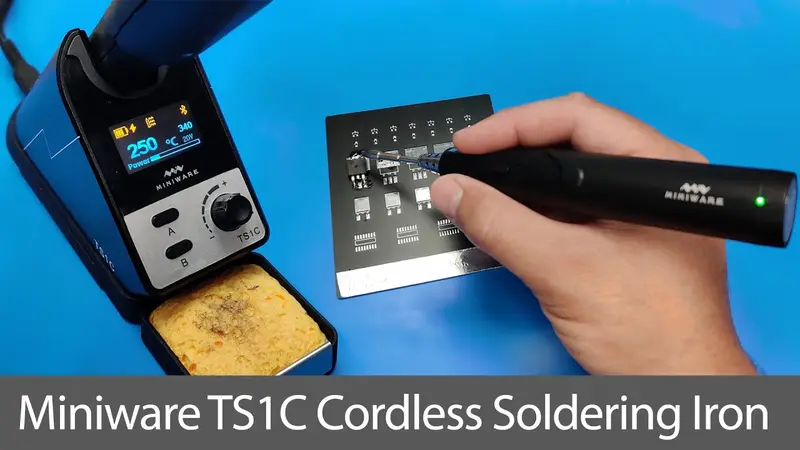
Miniware TS1C Cordless Soldering Iron Review & Teardown
Hands-on with the Miniware TS1C supercapacitor cordless soldering iron: teardown, calibration check, real runtime limits and who it actually suits.
 Length 14:59
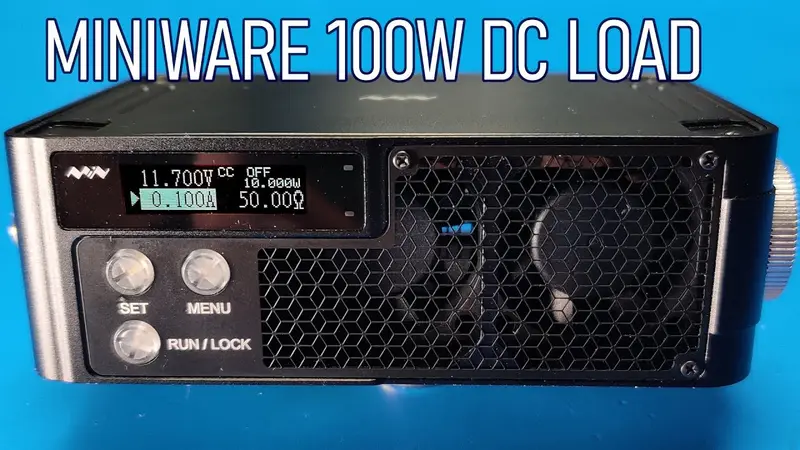
MiniWare L1060 Electronic Load Review: 60V 10A 100W
Hands-on review of the MiniWare MDP-L1060 electronic load: CC, CV, CR and CP modes tested, accuracy checked, MDP-01 display pairing and internal teardown.