Micsig MHO14-200 Review: 12-bit 200 MHz Portable Oscilloscope
Episode 376 ·
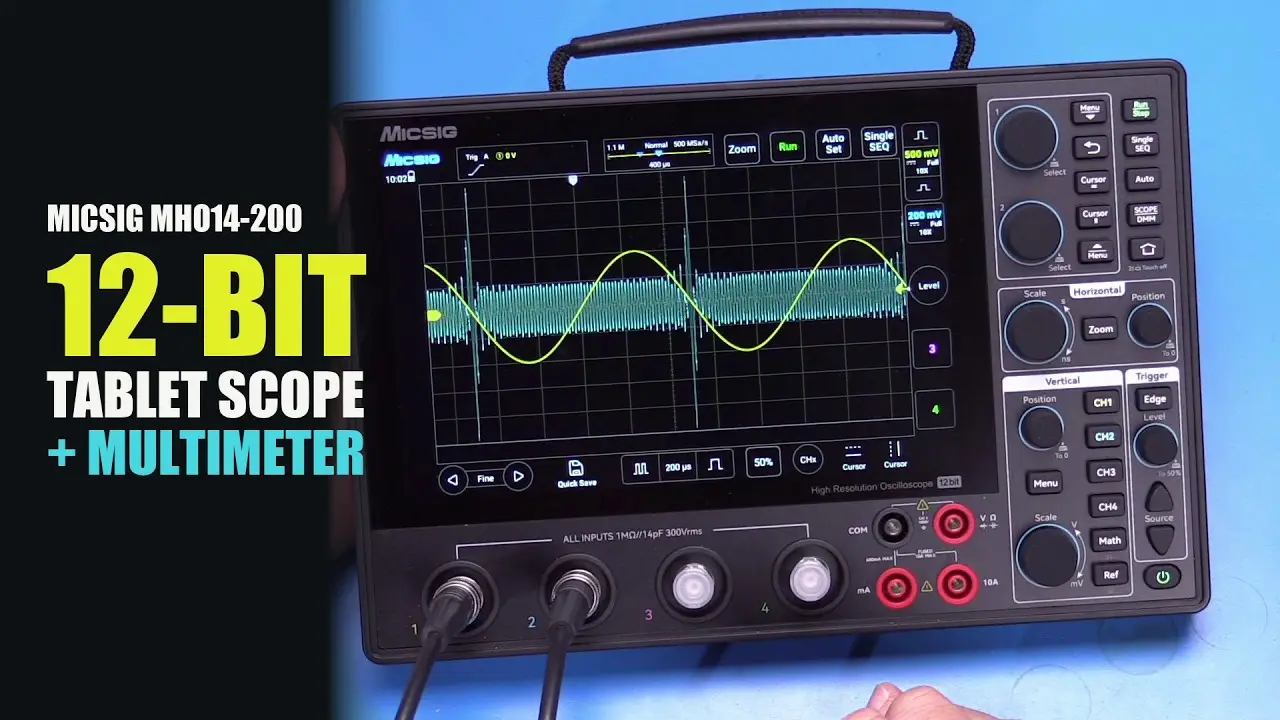
The Micsig MHO14-200 is a portable, battery-powered tablet oscilloscope with 200 MHz bandwidth, four channels, 12-bit resolution, a maximum of 1 GSa/s, 110 Mpts of memory and a built-in multimeter. eVision Instruments, a European supplier of test and measurement equipment, sent it for review, and code 5-STEVE gives 5% off at eVision. It has already been on the bench in #374, decoding the DMX output of a wireless lighting receiver. Beside the Micsig STO1004 from #280, it is slimmer and more modern. Its 8 inch 1280 by 800 touchscreen has an anti-glare finish that resists fingerprints and stays readable in bright sunlight, and rotary encoders replace the STO1004’s fiddly joysticks. On the back are a LAN port, which also serves the screen to a web browser, USB-C and USB-A, HDMI and a 12 V input. It charges and runs from USB-C too, drawing about 31 W (2.6 A at a negotiated 12 V) from a power bank. Choose that supply with care: many USB-C chargers float at around half mains through the capacitor across their flyback transformer, and that leakage shows up on whatever the scope is connected to. An earthed laptop supply, a 12 V adapter, or a mains earth connected to an unused channel’s BNC shell avoids it, since there is no separate earth terminal. The fan runs at one speed all the time, and with no vents on the sides the scope overheats if laid flat, so it has to stand upright. No case comes with it.
It runs Android, so the power button is a soft one on the front corner and easily pressed by accident; a recessed button on the back locks it, but needs a tool to reach. It boots in about 30 seconds. Nearly everything works from the touchscreen, including dragging and selecting waveforms and pinching the vertical scale, though not the timebase, which needs the encoder or buttons. Menus slide in from each edge of the screen: measurements, save, cursors, sample modes, display modes including XY and roll, and triggers that include maths and serial decode triggers. Serial decoding is built in, with no add-ons to buy: UART, LIN, CAN FD, SPI and I²C among others, two at a time, with the decoded data available as a table, and the interface stays quick throughout. The 12-bit converter gives 4096 levels instead of 256, so a stopped capture can be zoomed vertically and still show detail that the 8-bit STO1004 loses. The 1 GSa/s is for one channel; it halves to 500 MSa/s with two and drops to 250 MSa/s with three or four. Segmented memory records many events without spending memory on the gaps between them, then plays them back in order, overlays them or steps through them one at a time. Alongside FFT and the usual add, multiply and ax+b, an advanced maths mode evaluates a typed expression across the channels in real time.
The multimeter is one button press away: DC and AC voltage and current (with separate current jacks), AC plus DC, resistance, diode, capacitance and continuity, auto or manual ranging, and a trend graph that shows ripple a plain meter would miss. Against a PDVS2mini voltage reference, itself not calibrated for years, it read 8.999 V at 9 V, a few counts out as the voltage rose. None of the shrouded test leads tried, Hirschmann ones included, would go into its banana jacks, though; only unshrouded plugs fit, and those aren’t safe for general meter use. A thermal camera found about 43 °C on the front and 47.5 °C near the connectors on the back. After a couple of months of use, the verdict is that it is very good. Some of the interface could be streamlined, but at about £750 it is very good value, with enough features to make the premium brands hard to justify. It can be carried to an alarm panel or a car and run for a couple of hours on its battery, or sit on the bench as an ordinary scope.
More Micsig
 Length 20:14
Micsig STO1004 Review: 4CH 100 MHz Portable Scope
Hands-on look at the Micsig STO1004 tablet oscilloscope: 100 MHz, 4 channels, 1 GSa/s, serial decoding, HDMI out, battery life and the one real drawback.
 Length 24:08
Trailing Edge Dimmer: MOSFET vs IGBT + CP210A Probe
Comparing MOSFET and IGBT trailing edge dimmer designs on the bench, with current waveforms captured using the Micsig CP210A current probe.
 Length 6:22
Micsig DP20003 High Voltage Differential Probe Review
Hands-on look at the Micsig DP20003 differential probe: 5,600V range, 100MHz bandwidth and how it compares to the cheaper DP10013.