SDG Electronics

Fusing current

Estimate the current that will melt a copper conductor for a given pulse time.

Inputs

Results update as you change the inputs.

Pulse
mm
s
°C
×
Stack-up and copper
Layer

External layers only.

Total copper thicknessN/A

Result

Enter your values to calculate a result.

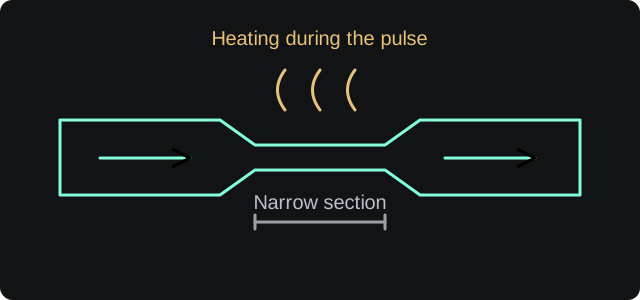
Conductor pulseA copper conductor carrying a current pulse for a given time.It = 1 s
Input guide
Current through a narrow copper section

A pulse heats the copper section. Enter its dimensions and the pulse duration to estimate the current that would melt it. This does not predict the behaviour of a protective fuse.

Illustration only. Not to scale.

Fusing current

N/A

Cross-sectionN/A
Circular milsN/A
Copper thicknessN/A
Melting pointN/A
Method and assumptions

Fusing current uses Onderdonk's adiabatic equation:I = A × √(log₁₀(1 + (Tm − Ta) / (234 + Ta)) / (33 × t)).

A is the conductor cross-section in circular mils, Tm is the melting point of copper (1084.62 °C), Ta is ambient temperature and t is time in seconds.

  • Intended for short pulse times, typically no more than 5 seconds.
  • Adiabatic model: heat loss to the board, planes and nearby copper is ignored.
  • This is a melting estimate, not a fuse curve or reliability rating.

Reference: Onderdonk's equation for copper conductors.

Estimate the effect of a short current pulse

This calculator estimates the current that raises a copper conductor to its melting point in the selected time. Use the trace current calculator for continuous loads. Use this calculator for short faults or current pulses.

What this does not model

  • Heat sinking into planes, thermal reliefs or surrounding copper.
  • Fuse opening, arcing or post-melting behaviour.
  • Long-term reliability, electromigration or repeated pulses.