SDG Electronics

Bandwidth and trace length

Estimate signal bandwidth and the length at which a trace should be treated as a transmission line.

Inputs

Choose rise time or frequency.

Input method
Signal
ns
ratio
Length limits

Result

Enter your values to calculate a result.

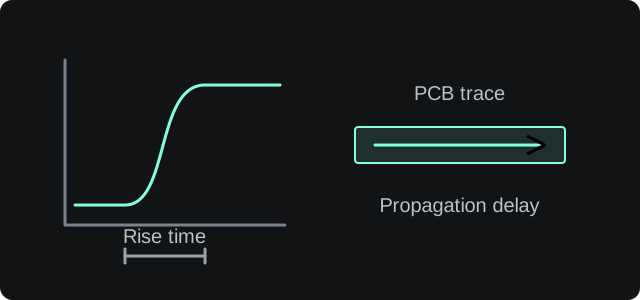
Rise time and propagation delay

The signal rise time determines the bandwidth estimate. Compare it with the propagation delay along the trace to judge when transmission-line effects become significant.

Illustration only. Not to scale.

Maximum conductor length

N/A

BandwidthN/A
Propagation speedN/A
Full wavelength in airN/A
Frequency-domain lengthN/A
Method and assumptions

Bandwidth uses BW = 0.35 / tr. Propagation speed is c / √Er. The frequency-based length limit is the selected fraction of the wavelength in air.

The rise-time length limit uses the IPC-2251 rise-distance method with the selected fraction of Sr. The microstrip form uses an empirical fit. The stripline form uses the propagation speed in a uniform dielectric.

  • These are transmission-line screening rules, not impedance or field-solver results.
  • The frequency method does not use Er or the trace type.

Compare route delays and length matching

Compare the result with your trace length

Compare the physical trace length with the result. If the trace is longer, treat it as a transmission line and control its impedance. The exact threshold depends on the edge rate and the acceptable overshoot.