Conversions for the workbench
All sections update independently. The dBm chain assumes a matched system impedance. The displayed RMS voltage would produce the calculated power in that impedance.
SDG Electronicssdgelectronics.co.uk/tools/pcb-calculator/conversion/
Common PCB and RF conversions in one place.
Enter your values to calculate a result.
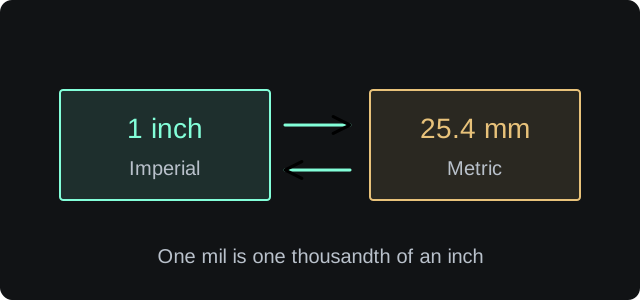
Choose the input unit before entering a value. Each section works independently, so you can convert a distance, temperature, gain or angle without filling in the other sections.
Illustration only. Not to scale.dBm out
N/A
Distance uses 1 in = 1000 mil = 25.4 mm. Temperature uses the standard linear conversion.
Voltage gain from dB uses 10^(dB/20). Output power in dBm is the input power plus gain, less attenuation. The output voltage is the RMS value for the selected system impedance.
Polar conversion uses |Z| = √(R² + X²) and angle = atan2(X, R).
All sections update independently. The dBm chain assumes a matched system impedance. The displayed RMS voltage would produce the calculated power in that impedance.