SDG Electronics

Crosstalk (experimental)

A rough near-end crosstalk estimate for parallel traces. Treat it as an order-of-magnitude check only.

Inputs

Results update as you change the inputs.

Signal
ns
V
mm
Geometry
mm
mm
mm
ratio

Result

Enter your values to calculate a result.

Coupling between neighbouring traces

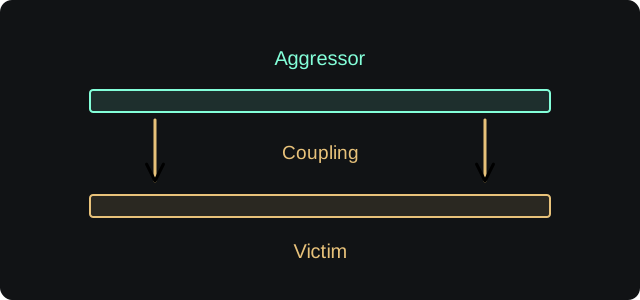
The aggressor carries the switching signal. Some energy couples into the neighbouring victim trace. This experimental estimate uses the spacing, geometry, coupled length and rise time.

Illustration only. Not to scale.

Coupled voltage

N/A

Coupling coefficientN/A
NEXT coefficientN/A
CrosstalkN/A
Saturation lengthN/A
Method and assumptions

This is a simple backward-crosstalk rule of thumb:Kb = 1 / (4(1 + (S/H)²)), with NEXT scaled by coupled length up to the saturation length.

  • It ignores conductor width, thickness, terminations, ground-plane effects and many geometry details.
  • This model has limited accuracy. Use a coupled-line field solver for production work.
  • The differential-pair NEXT section uses a more complete coupled-line formulation.

Use this for an initial estimate

The result is useful only for a quick rough check. Coupled-line crosstalk depends on the full stack-up, trace geometry, terminations and the switching pattern. If crosstalk matters, use a field solver or measured data.